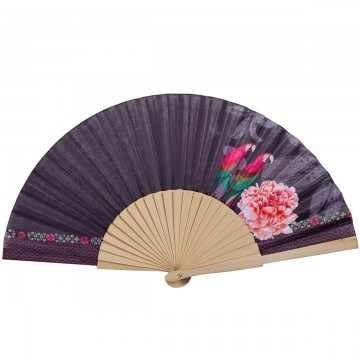
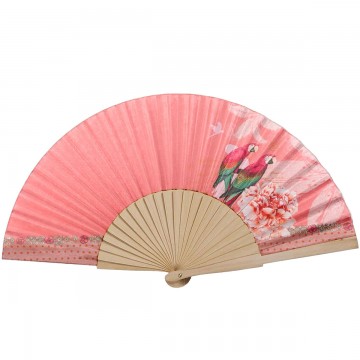
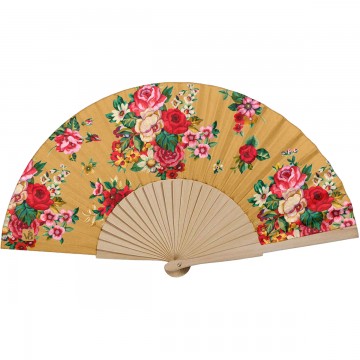
The Chinese hand fan goes back a very, very long way. It is thought to have been in use for more than 3,000 years. The modern fan, for its part, came into being during the Han dynasty, that is from 206 BC to AD 220, and therefore after the Qin dynasty. It then gradually developed into a variety of models: feather fans, palace fans, folding fans, black paper fans, plumed fans, palm-leaf fans, gong fans, ivory fans, sandalwood fans... Here's a closer look at the Chinese hand fan.
The invention of the Chinese fan
China began producing fans during the second imperial dynasty. A famous writer of the time, Ban Jieyu, expressed her admiration for the object, saying: “The newly spun silk of Qi is as white as snow; the round fans are made of pieces of silk like the full moon.”
A little later, a new type of fan appeared: the folding fan. It became especially widespread during the Northern and Southern dynasties and was very widely used during the Ming and Qing dynasties.
How Chinese fans were used
It is worth noting that the first Chinese fans were made of feathers. They were designed specifically to keep cool and to ward off dust and insects. Hence the remark by Wang Dao, prime minister of the Jin dynasty: “I often use my fan to protect myself from the dust and to cool down in summer.” Everyone used them in daily life, men and women alike, whatever their social class.
The Chinese valued the fan for its practicality. And at times, they also used it to accessorise their outfits. Decorative models, in particular, were made from quality materials. They featured beautiful patterns and can be considered true works of art. There were also ivory fans. These accessories were symbols of high-ranking power, which is why they were mainly used as tributes to the imperial court.
Chinese fans today
Nowadays, it has to be admitted that the use of Chinese fans has declined. People are no longer interested in these accessories, because they can replace them with more modern appliances such as electric fans and air conditioning. But that doesn't mean Chinese fans are old-fashioned. They still hold an important place in Chinese culture and tradition. And they have also retained their artistic value.
Discover our hand fan collections