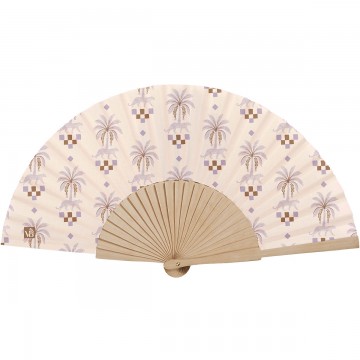
The hand fan landed in Europe when the Portuguese returned from Japan. It arrived on the continent in the 16th century, along with cargoes of spices and silks carried in Portuguese trunks that came straight from Japan. It quickly won over prominent figures and became a luxury item among the nobility.
The arrival of the fan in Europe
Folding hand fans were discovered by the Portuguese in 1549, after Saint Francis Xavier arrived in Japan. They were brought straight back to Lisbon and sold on the city's market. Italian buyers then acquired them and copied them, spreading them throughout Europe. Later, painters and engravers took up the object and went on to develop models with impressive designs, true works of art.
The fan, an object of power
During the Renaissance, fans were above all an object of power. They were carried by Europe's great women, including Elizabeth I in England and Catherine de' Medici in France. Henri III also helped to promote this accessory in France. The same was true of Marie de' Medici when she married Henri IV. In 1678, Louis XIV, together with his minister Colbert, created the fan makers' guild. At the time, any craftsman who pleated and mounted fan leaves was classed as a fan maker. Craftsmen who made the sticks in the Oise, on the other hand, were considered tabletiers (craftsmen working in wood, ivory and mother-of-pearl).
Famous European fans
One of the first and most famous European fans is now kept in the Cabinet des Médailles at the Bibliothèque Nationale in Paris. This fan is said to have belonged to Diane de Poitiers, the mistress of Henri II. One of the finest achievements of 17th-century painters and engravers is the screen leaf for the Medici, a fan made by Jacques Callot from Lorraine depicting a festival on the Arno. Nor should we forget the famous series of leaves engraved by Abraham Bosse in 1637. In fact, a number of different trades were involved in the 17th century in producing beautiful fans of all kinds, to name but a few: gilders, glovers, pleaters, tabletiers and perfumers.
The development of fan production in Europe
Factory production of fans did not appear until the middle of the 18th century. And in 1760, Martin Petit invented a pleating mould system that allowed fans to be mass-produced. Towards the end of the 18th century, the mass production of printed fans heightened with stencilled colour began. This was the golden age of the fan in Europe.
Discover our hand fan collections