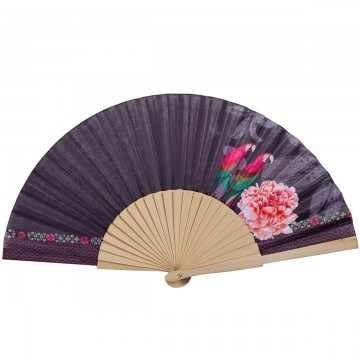
Inseparable from Japanese culture, the hand fan is not just a simple tool for fanning oneself. It has its own history and values, and to this day it still holds an important place in Japanese culture. In fact, the Japanese fan has come a long way to become what it is today. Here's everything you need to know about this elegant, refined accessory.
A brief history of the Japanese fan
The very first fan to originate in Japan was the folding fan known as the “sensu”. It was the product of a peasant's imagination, inspired by the wings of bats, which can fold and unfold. During the Heian period, its use was reserved for members of the high court. Laws were even passed to restrict its use by certain social classes. At the time, it was also an essential accessory in traditional Japanese art. It featured prominently in Noh and Kabuki theatre, in the narrative art of rakugo and in traditional dance. It was not until the 17th century that the use of the Japanese fan was granted to all social classes, without exception. And the country began to export its fans abroad.
The different types of Japanese fan and their uses
The Japanese fan comes in several forms. The sensu or ogi fan is the most popular. It is usually made from bamboo and Japanese paper, and it stands out for its compactness and practicality. It is perfect for accessorising elegant outfits and traditional dress. It also lets you cool down quickly. This folding fan is also very easy to store and carry. It is light and takes up little space, and it can be folded when not in use. As well as the sensu fan, there is also the uchiwa fan. This model consists of a handle and a fixed fabric screen. It cannot be folded, which gives it the look of a table tennis bat. It is the ideal fan for festivals and major ceremonies. It even makes a good promotional giveaway for companies today. Finally, let's not forget the gunsen, or war fan. This Japanese fan is a real weapon. It has steel sticks and can be used to give orders, or even to defend or attack. In fact, it is the kind of fan used by military commanders in the Middle Ages. But nowadays, it is rarely sold in shops and rarely used.
Discover our hand fan collections