
Your cart
There are no more items in your cart
In a contemporary living room, a wall hanging acts as a single focal point: you hang one, not three. Choose a pattern that picks up two colours already present in the room, place it above a low piece of furniture rather than on an empty wall, and respect the proportions—the wall hanging should take up between half and two thirds of the width of the furniture it hangs above.
Why a wall hanging works well in a modern interior
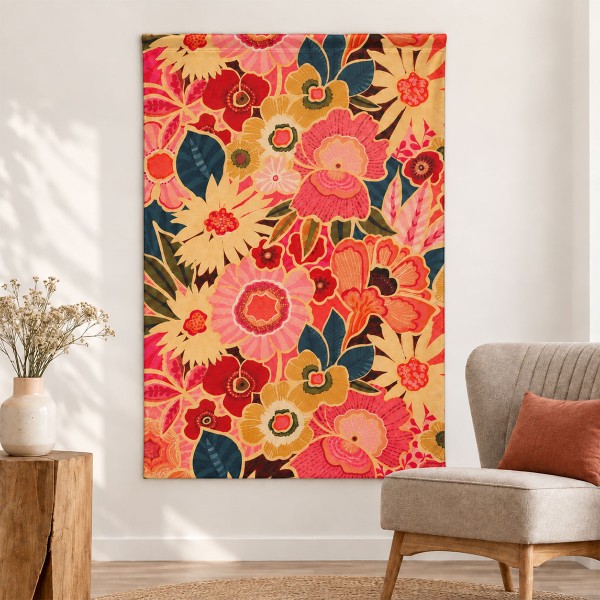
Calm furniture, a clear wall, a single touch of colour: KIMIKO in a contemporary living room.
Contemporary living rooms share three traits: straight lines, smooth surfaces and tight palettes—white, grey, light wood, matt black. They are clean-cut, and sometimes a little austere.
That is exactly what makes textiles on the wall interesting. They bring three things a frame doesn't:
Texture. A painted wall and a plain fabric sofa reflect light in the same flat way. A pile fabric, on the other hand, changes appearance with the time of day and the angle: the same pattern doesn't read the same way in the morning and in the evening.
Acoustic softness. Modern interiors sound hollow—wooden floors, large glazed surfaces, few curtains. A thick textile on a wall absorbs some of the reverberation. It isn't acoustic treatment, but in a sparsely furnished living room, you can hear the difference.
Reversibility. This is the point people underestimate: you can take a wall hanging down in ten seconds. In a room that took you a long time to get right, being able to change just one thing without repainting anything is worth a lot.
The four decisions, in order
1. The location, before the pattern
The most common mistake is to choose a pattern first and then look for a wall to put it on. Do the opposite.
The three locations that work in a living room:
- Above a low piece of furniture—a console table, sideboard or dresser. The best of the three: the furniture provides a visual base and the wall hanging extends the vertical line.
- In the reading corner—behind an armchair, next to a lamp. This is the setting you see in most of our photos, and it's no coincidence: the vertical format of a wall hanging suits this arrangement perfectly.
- On a narrow section of wall—between two openings, or along a hallway. A vertical wall hanging makes a short wall look longer.
The wall behind the sofa is trickier than it looks: a 90 cm panel above a 200 cm three-seater sofa covers only 45% of the width and seems to float. On that wall, plan for two panels side by side.
2. The proportions
The rule fits on one line: between half and two thirds of the width of the furniture the wall hanging sits above.
| Furniture | Wall hanging width to aim for | How a 90 cm panel works |
|---|---|---|
| Console table 100-120 cm | 60 to 80 cm | slightly wide, but acceptable |
| Sideboard 150-180 cm | 80 to 120 cm | ideal proportions |
| Single armchair | 70 to 100 cm | ideal |
| 3-seater sofa 200 cm | 100 to 135 cm | too narrow on its own → two panels |
As for height: the bottom of the wall hanging should sit 20 to 30 cm above the furniture, and on a bare wall, the centre of the pattern should be at eye level, around 150-160 cm from the floor. Don't push a wall hanging up towards the ceiling to fill the space: it cuts the wall in two and makes the room look smaller.
3. Colour: two echoes, no more
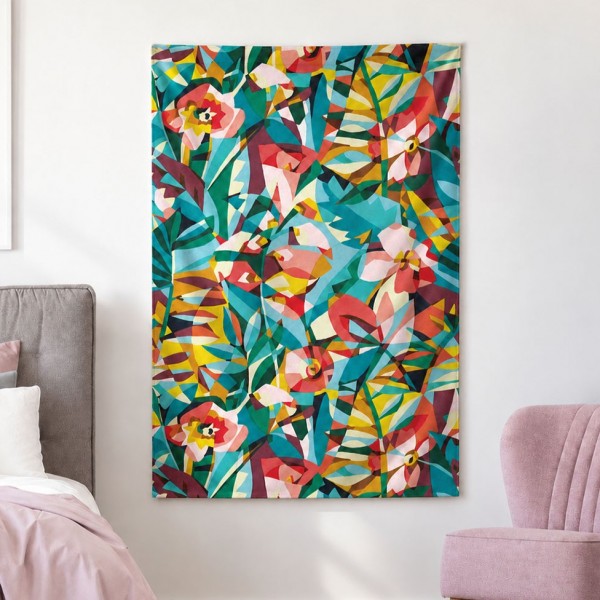
The turquoise of BOA picked up on a cushion and an object is enough to pull the whole look together.
This is the rule that rescues understated interiors. Choose a pattern with two colours that already exist in the room—the wood of a coffee table, a cushion, the spines of your books, the green of a plant. The wall hanging then stops looking like an add-on: it looks as though it set the tone for everything else.
There's no need to go further: a pattern that picked up all the colours of the living room would become decorative in the wrong sense of the word.
Two special cases:
- A very light living room, all white and wood: a pattern on a dark background creates a clear anchor point. That's the role of LOUISON, whose roses and peonies open out against a burgundy and midnight-blue background.
- A living room that is already colourful, with a printed sofa and patterned rug: don't add a dense pattern. Here, a wall hanging may not be called for at all—and saying so is part of good advice.
4. Finally, the pattern
In a contemporary interior, two families work particularly well.
Graphic patterns, with bold flat colours and crisp outlines, which echo the straight lines of the furniture. BOA is a good example: a faceted jungle in shards of turquoise, yellow, red and pink. It brings colour without bringing nostalgia.
Line-drawn stylised florals, less literal than a naturalistic bouquet. KIMIKO, with its large flowers drawn in fine lines in coral pink, red and gold on teal foliage, or JAVA, whose cut-out flowers in flat colour mix red and bright pink with turquoise.
For a softer living room in natural tones, TAÏNA, with its powder-pink background, brings colour without raising its voice.
Three common mistakes
Hanging it too high. This is mistake number one, and it comes from a good intention: you want to “fill” the wall. A wall hanging whose bottom edge is at shoulder height looks as though it's suspended in mid-air.
Multiplying focal points. A wall hanging, a large painting and a gallery wall of frames in the same room cancel each other out. If you hang a wall hanging, keep the rest of the wall clear.
Choosing the colour on screen without checking the light in the room. A north-facing living room dulls cool colours; a south-facing one washes out pastels. Look at photos of the room taken at the time of day when you actually spend time there.
Frequently asked questions
What size wall hanging for a living room? Between half and two thirds of the width of the furniture it hangs above. A 90 × 135 cm panel suits a console table, a sideboard or an armchair; behind a three-seater sofa, plan for two.
Where should you hang a wall hanging in a modern living room? Above a low piece of furniture, in a reading corner behind an armchair, or on a narrow section of wall. The bottom of the wall hanging should sit 20 to 30 cm above the furniture.
What colour wall hanging for a grey and white living room? A pattern that picks up two colours already present in the room. In a very light living room, a dark background creates a clear anchor point.
Can you put a wall hanging in a contemporary interior? Yes—in fact, it's one of the settings where it works best: it brings texture, colour and acoustic comfort to a room full of smooth surfaces.
Read next: Wall hangings: the complete guide · How to hang a wall hanging · see the six patterns