
Your cart
There are no more items in your cart
There are seven ways to hang a wall hanging, from the most discreet to the most temporary. The simplest needs nothing more than two nails, placed inside the rod sleeve: once the wall hanging is pulled taut, nothing shows. Next come the rod on hooks, the curtain pole, adhesive strips, Velcro, the poster hanger and the taut cord. Your choice depends on the weight of the wall hanging and the type of wall — not on style.
First: how much does your wall hanging weigh?
Everything starts here, and it’s good news. A Vent de Bohème wall hanging measures 90 × 135 cm in a 340 g/m² fabric: it weighs 450 g. Less than a picture frame of the same size.
That means you need no heavy-duty wall plug, no reinforced pole and no tools. Two nails are enough — and if you can’t put anything into the wall at all, three of the methods below leave no trace.
Method 1 — Two nails hidden in the sleeve
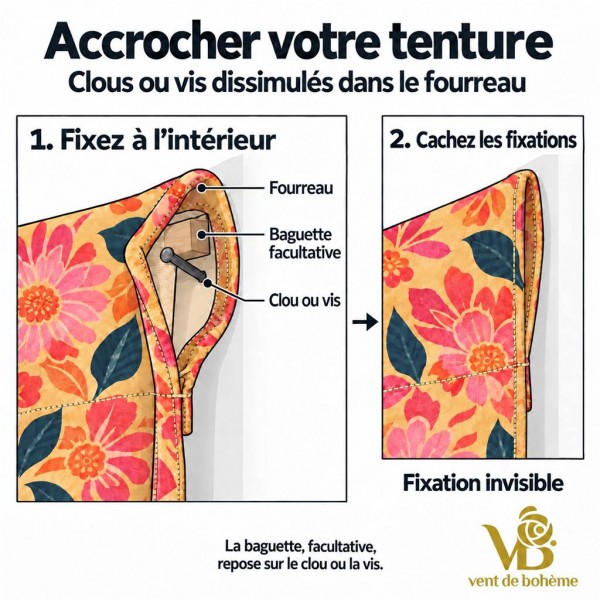
The nails sit inside the sleeve, at each end: they disappear once the fabric is pulled taut.
The most discreet method, and the one we use. The top of the wall hanging is finished with a rod sleeve — a folded-over hem that forms a tunnel across the full width. The sleeve is designed to take a rod, but it can just as easily hold two nails driven into the wall. The heads disappear inside, the wall hanging stretches between them, and from the front you see nothing: no fixing, no rod, no hook. Just the pattern.
- Drive in the first nail (or a screw, depending on the wall) at your chosen height.
- Mark the position of the second with a spirit level, not by eye: it’s the one step that shows if you get it wrong.
- Slip the sleeve over the first nail, then over the second.
- Pull the fabric taut between the two points before letting go. It’s the tension that keeps the top perfectly straight; a wall hanging put up loosely will ripple.
A rod is still an option, but it’s optional. Slid into the sleeve, it rests on the same nails and stiffens the top of the wall hanging. It’s useful if your wall is uneven or if you want a perfectly straight edge. It isn’t included: a thin wooden batten the width of the wall hanging will do.
Who it’s for: pretty much everyone. It’s the default method.
Method 2 — A visible rod on two hooks
Here the rod is no longer hidden: it sticks out on either side and becomes part of the decor, resting on two hooks screwed into the wall.
Allow a 110 cm wooden batten or dowel for a wall hanging 90 cm wide — 10 cm of overhang on each side is the proportion that gives a finished look. Oak and walnut suit warm patterns; pale beech and bamboo suit graphic ones.
Who it’s for: walls you can drill, and anyone who wants the hanging itself to be on show.
Method 3 — A curtain pole
The same principle with a proper curtain pole and its brackets. Wider, and above all, you can slide the wall hanging along it. Handy when it covers a wall you walk past, or when it hides a disused door, a shelf or an alcove.
A curtain pole can easily take 450 g — it’s designed for lined curtains that weigh ten times as much.
Who it’s for: a wall hanging you want to be able to draw aside.
Method 4 — Adhesive mounting strips
Removable adhesive hooks hold anything from 500 g to 3.5 kg, depending on the model. Two are more than enough.
Three conditions for them to hold:
- A smooth, clean wall: satin paint, tiles, glass, varnished wood. On chalky matt paint, textured render or textured wallpaper, the adhesive pulls the surface off when it comes away.
- Degrease with alcohol before fixing, not with a household cleaner, which leaves a greasy film.
- Wait an hour before hanging anything. The adhesive reaches full strength after an hour, not straight away.
Who it’s for: renters, and walls you don’t want to drill at all.
Method 5 — Velcro
A hook-and-loop strip: the soft side sewn or glued to the top of the wall hanging, the hook side fixed to the wall or to a batten. The fabric sits flush against the wall with no gap, like a stretched panel. It’s the flattest finish, and no fixing is visible.
Who it’s for: a clean, flat look.
Method 6 — The poster hanger
Two wooden strips that clamp the top of the wall hanging, suspended from a single hook. It takes two minutes to put up, and you can swap wall hangings as quickly as you’d swap a poster.
Who it’s for: trying things out, seasonal changes, children’s rooms.
Method 7 — The taut cord
Two nails, or two existing hooks, a cord stretched between them and the sleeve resting on top. Rustic, light and often the quickest option when the fixings are already on the wall.
Who it’s for: quick fixes, walls already drilled, a workshop feel.
Concrete walls
Concrete doesn’t forgive improvisation, but it’s no trouble with the right tool. An ordinary nail won’t go in: you have to drill.
- A hammer drill is a must — an ordinary drill driver just spins and overheats.
- A masonry bit (carbide tip), 6 mm in diameter for a light fixing.
- A 6 mm universal nylon wall plug, pushed in flush with the wall, then a flat-head screw that will fit inside the sleeve.
- Drill slowly, pulling the bit out regularly to clear the dust.
In aerated concrete, a standard nylon plug won’t hold: you need a specific plug that screws directly into the material.
And if drilling the concrete isn’t an option — a load-bearing wall, concealed cables or pipes, a rented home — methods 4, 5 and 6 work perfectly, as long as the surface is smooth.
Plasterboard walls
A thin nail driven in at an angle will hold a 450 g wall hanging with no trouble. If you’d rather use a screw, or if the wall is already worn at that spot, use a metal cavity anchor (Molly type): drill to the diameter shown on the anchor, insert it, expand it, then put in the screw. A screw driven into bare plasterboard, on the other hand, will pull out at the first tug.
And without making any holes?
Three methods, in order of reliability:
- Removable adhesive hooks — the best balance of hold and discretion. They come off without a mark when you pull the tab downwards, parallel to the wall.
- Adhesive Velcro — excellent hold on a smooth surface, trickier to remove.
- A tension rod (spring-loaded pole) — wedged between the two walls of an alcove or a recess, with no fixings at all. Only works in a recessed space.
Avoid: reusable adhesive putty, which stains pale paintwork and gives way as soon as the room warms up.
How high should you hang it?

Above a bed, the top of the panel usually sits between 15 and 25 cm from the headboard. Shown here: BOA.
- Above a bed: bottom of the wall hanging 20–25 cm above the headboard.
- Behind a sofa: bottom of the wall hanging 20–30 cm above the backrest.
- On an empty wall: centre of the pattern at eye level, about 150–160 cm from the floor.
- Under a high ceiling: don’t push the wall hanging up to the ceiling to “fill” the space. A wall hanging placed too high cuts the wall in two and makes the room look smaller.
Frequently asked questions
How do you hang a wall hanging without a rod? Drive two nails into the wall and slip the rod sleeve at the top of the wall hanging over them. The nail heads stay hidden inside the sleeve and the fabric, pulled taut between the two points, hangs straight. It’s the most discreet method: nothing is visible from the front.
How do you hang a wall hanging without making holes? With removable adhesive hooks, adhesive Velcro or a tension rod in an alcove. The wall must be smooth, clean and degreased, and you need to wait an hour after fixing before hanging the wall hanging.
How do you fix a wall hanging to a concrete wall? A hammer drill, a 6 mm masonry bit, a universal nylon wall plug, then a flat-head screw that fits inside the sleeve. Or, without drilling, adhesive hooks if the concrete is smooth and painted.
Does the wall hanging come with a rod? No, and you don’t really need one: two nails in the sleeve are enough. If you want one, get a wooden batten or dowel — the width of the wall hanging for a hidden rod, or 110 cm for a visible rod that overhangs by 10 cm on each side.
Can a wall hanging be hung from the ceiling? Yes, on hooks with plugs suited to the type of ceiling, to create a bed canopy or divide a space. Check what the ceiling is made of: a plasterboard ceiling needs cavity anchors.
How do you get a wall hanging to hang perfectly flat? Pull it taut between its two fixing points when you put it up, then leave it for 48 hours: most of the fold creases drop out on their own. Vent de Bohème wall hangings can be ironed — always on the reverse, so as not to flatten the velvet pile.
Read next: Wall hangings: the complete guide · How to clean and care for a wall hanging · our wall hangings