
Your cart
There are no more items in your cart
A wall hanging is a piece of decorative textile suspended on a wall, usually from a rod, a curtain pole or fixings. It dresses a large surface without drilling lots of holes, softens the acoustics of a room and can be changed with the seasons — three things a frame simply can't do.
Long the preserve of châteaux and grand bourgeois interiors, the wall hanging has become an everyday decorative object again. This guide brings together what you need to know before choosing one: materials, sizes, styles, how to hang it and how to look after it.
What exactly is a wall hanging?
Originally, the French term for a wall hanging referred to all the fabrics furnishing a room — walls, doors, sometimes the ceiling. In today's usage, a wall hanging is more simply a decorative fabric panel designed to be hung, most often printed or woven with a pattern.
The most famous example in France is the Apocalypse Tapestry, woven at the end of the 14th century for Louis I of Anjou and kept at the Château d'Angers: around a hundred metres of wool telling the text of Saint John. It's a far cry from a contemporary decorative object, but the principle hasn't changed — a textile image, at eye level, that gives a room its character.
Wall hanging, tapestry, fabric-covered wall: three different things
| How it's made | How it's put up | Reversible? | |
|---|---|---|---|
| Wall hanging | Printed, woven or embroidered fabric, hemmed | Hung (rod, curtain pole, fixings) | Yes, in a few minutes |
| Tapestry | Pattern woven into the weft of the fabric itself | Hung, often lined | Yes |
| Fabric-covered wall | Fabric stretched by an upholsterer over wooden battens | Fixed to the wall, semi-permanent | No, it's a proper job |
If you're looking to change the look of a wall this weekend, a wall hanging is what you need. A fabric-covered wall, on the other hand, is a home improvement project.
Why a wall hanging rather than a frame?
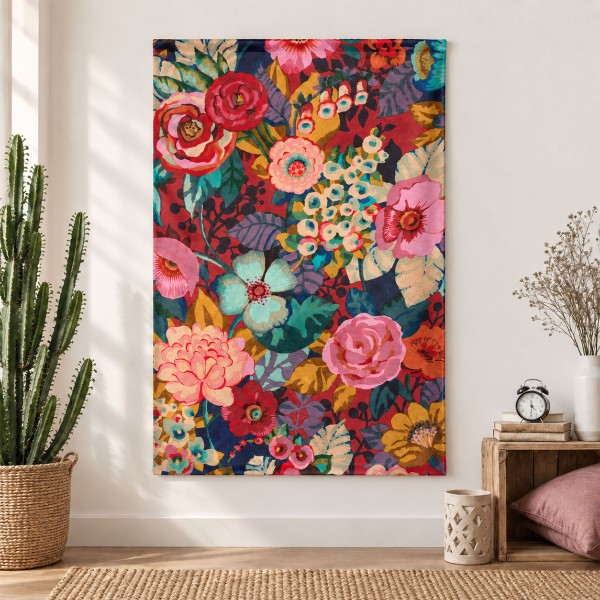
A wall hanging brings a texture to the wall that the glass of a frame can't. Here, LOUISON, 90 × 135 cm.
It covers a lot of wall with few holes. A three-metre wall calls for five or six frames, so just as many holes to drill and a gallery wall to line up. A wall hanging covers the same area with two fixing points, sometimes none at all.
It softens sound. A thick textile against a hard surface absorbs some of the mid and high frequencies. In a sparsely furnished room with tiles or bare floorboards, you can hear the difference in the echo — it isn't professional acoustic treatment, but it's not nothing.
It's reversible. Rented flat, concrete wall, fancy a change in autumn: just take it down, roll it up and put it away.
It adds texture. A painted wall stays flat. Velvet catches the light differently depending on the time of day and the angle: the pattern never reads quite the same in the morning as in the evening.
Materials: what really makes a difference
This is the most decisive choice, even before the pattern.
| Material | Drape | Print quality | Care | Best for |
|---|---|---|---|---|
| Cotton or silk velvet | Heavy, hangs very flat | Deep, but digital printing doesn't take well | Usually dry clean only | Statement pieces, high budget |
| Polyester velvet-effect | Heavy, hangs very flat, stable | Deep colours, crisp design, shifting light | Machine washable depending on the fabric | Living room, bedroom, family spaces |
| Cotton | Light, can ripple | Matt, bold colours | Machine washable on a cold wash | Children's rooms, moving around |
| Linen | Supple, falls in soft, lively folds | Soft, slightly irregular | Delicate, creases easily | Natural interiors, raw style |
| Thin polyester | Very light, floats | Bright but slightly plasticky | Easy | Tight budgets, temporary decor |
Velvet deserves a closer look, because this is where the difference lies between a wall hanging that looks like decor and one that looks like a poster. The weight of the fabric directly determines the drape: if it's light, the panel ripples and creases; if it's heavy, it hangs straight as soon as it's up.
Vent de Bohème wall hangings are printed on a 340 g/m² polyester velvet-effect fabric, made in Milan, Italy. To put that in context: printed upholstery velvets generally range from 290 to 410 g/m². At 340, it sits in the upper half — heavy enough to hang straight without ironing, supple enough to roll up and store.
→ A material-by-material breakdown: What fabric for a high-quality wall hanging?
Sizes: what size for which wall?
The simple rule: a wall hanging should take up between half and two thirds of the width of the wall or the piece of furniture it hangs above. Any smaller and it looks lost; any bigger and it overwhelms.
Vent de Bohème wall hangings measure 90 × 135 cm and weigh 450 g — a portrait format, lighter than a frame of the same size, that suits most situations at home:
| Situation | What a 90 cm panel gives you |
|---|---|
| Above a 140 cm bed | 64% of the width — the ideal proportion |
| Above a 160 cm bed | 56% — just right, but balanced |
| Above a console table or an armchair | perfect, the most flattering placement |
| Narrow wall, hallway, between two doors | perfect, the portrait format makes the wall look taller |
| Behind a 3-seater sofa (200 cm) | 45% — a single panel looks small, two panels side by side work better |
| Large bare wall of 3 m or more | two or three panels, in a row or staggered |
Two height guidelines: the bottom of the wall hanging usually sits 20–25 cm above the headboard or the back of the sofa, and the centre of the pattern at eye level, about 150–160 cm from the floor, when the wall is clear.
The main style families
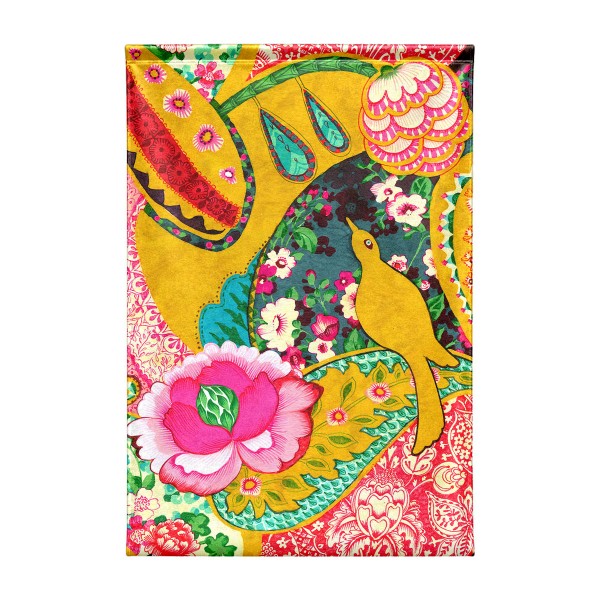
The floral and paisley repertoire: PAJARO, a golden bird on a saffron background.
Boho — organic patterns, a warm palette, an unapologetic mix of references. This is Vent de Bohème's home turf: the pattern is designed to live with a bit of clutter around it, not to reign over an empty wall.
Floral and botanical — the easiest family to work into a room. In our collection, it ranges from the tropical bouquet on a pink background of TAÏNA to the dense, dark garden of LOUISON, by way of the graphic flowers of JAVA and the golden suns of KIMIKO.
Indian — mandalas, trees of life, paisleys, block-printed cottons. The most searched-for family online, and the one where the gap is widest between a carefully printed piece and a lacklustre reproduction. This is the spirit of PAJARO, with its bird and paisleys.
Japanese — waves, cranes, mountains, broad flat areas of colour and deliberate empty space. A style that needs a calm wall around it.
Graphic — bold blocks of colour, cut-out shapes, colours that echo one another. BOA is a good example: foliage reworked into turquoise, red and yellow facets, which works in a light bedroom without weighing it down.
→ See all six patterns: our wall hangings
How to hang it
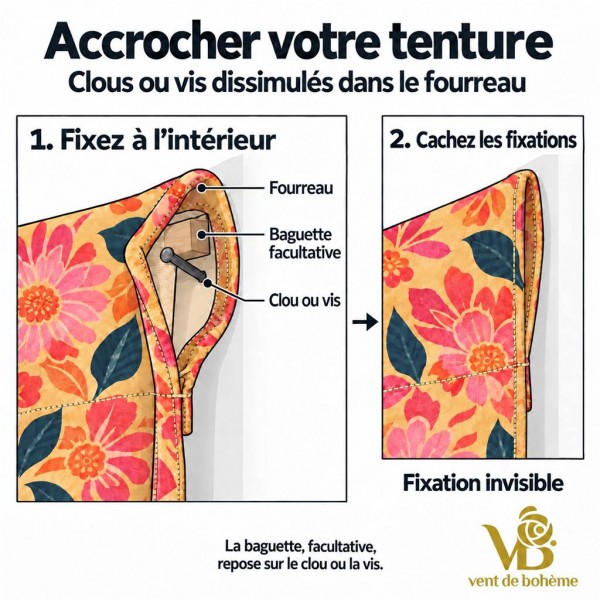
Two nails tucked inside the rod sleeve: the fixing can't be seen. The rod is optional.
The simplest method needs nothing more than two nails. The top of the wall hanging is finished with a rod sleeve — a folded hem that forms a tunnel across the full width. The two nails in the wall slip inside it: the heads disappear inside, the fabric pulls taut between them, and from the front you see neither fixings nor rod. Just the pattern.
A rod is still an option — slid into the same sleeve, it stiffens the top and can stick out on each side to become part of the decor. It isn't included, and it isn't necessary.
That leaves five other solutions, depending on the wall and your mood: curtain pole, adhesive strips, Velcro, poster hanger, taut cord. At 450 g, a wall hanging is no problem for adhesive fixings, which typically hold 1 to 3 kg — reassuring news for renters.
→ Each method in detail, including concrete walls and hanging without a single hole: How to hang a wall hanging
Care
This is where a velvet wall hanging usually has a nasty surprise in store: most are dry clean or spot clean only, and a stain that isn't dealt with properly stays. Not so here.
Vent de Bohème wall hangings are machine washable at 30 °C and can be ironed. In practice, that means they can live in a child's bedroom, a kitchen or a living room where people eat, without the first stain being a disaster.
- Washing: machine wash at 30 °C. Remove the rod and take the wall hanging out as soon as the cycle ends to hang it up — that's what prevents most creases.
- Ironing: yes. With velvet, always iron on the reverse side so as not to flatten the pile.
- Everyday dust: a soft brush or the vacuum cleaner on low power, in the direction of the pile, is enough between washes.
- Light: like any printed textile, a wall hanging in full sun all day long will eventually change. That's not a defect, it's just textile.
Where to buy a quality wall hanging?
Four things to check before you order, whatever the shop:
- Is the fabric weight stated? A product page that doesn't give it is often hiding a lightweight fabric.
- The finishing: hems on all four sides, a sleeve or loops for hanging. A raw cut edge without a hem loses its shape within a few months.
- Where the pattern and fabric come from: an original design isn't a file bought from an image bank. The six patterns in the Winter 2026 collection — TAÏNA, JAVA, PAJARO, LOUISON, KIMIKO, BOA — are designed for Vent de Bohème, and the wall hangings are made in Milan, Italy.
- A photo in a real setting, with a piece of furniture next to it: it's the only way to judge size on a screen.
Frequently asked questions
What's the difference between a wall hanging and a tapestry? A tapestry has its pattern woven into the weft; a wall hanging is a printed, woven or embroidered fabric panel that you hang up. In everyday decorating, the two words are often used interchangeably.
What size wall hanging should I choose? Between half and two thirds of the width of the wall or piece of furniture in question. A 90 cm panel suits a 140 cm bed, a console table or a narrow wall; for a three-seater sofa, plan on two panels.
How do you hang a wall hanging without a rod? Hammer two nails into the wall and slip the top sleeve over them: the heads stay hidden inside, and the taut wall hanging falls straight. Nothing is visible from the front.
Can you hang a wall hanging without drilling at all? Yes: adhesive wall-mounting strips, Velcro, or a poster hanger suspended from an adhesive hook. A 90 × 135 cm wall hanging weighs 450 g, well below what these fixings can hold.
Can a velvet wall hanging be washed? It depends on the fabric: many printed velvets are dry clean or spot clean only. Vent de Bohème wall hangings are machine washable at 30 °C and can be ironed on the reverse side.
Is the rod included? No, and you don't really need one: two nails slipped into the sleeve are enough. If you'd like one, a simple wooden batten does the job.
Does a wall hanging insulate against cold or noise? It dampens some of the echo in a room and creates a thin layer of still air against the wall. The effect is real but modest: it's a comfort, not insulation.
What fabrics make a high-quality wall hanging? Upholstery velvet, thick linen and heavy cotton. What matters isn't the name of the material but its weight per square metre and the quality of the finishing.
Want to find out more? How to hang a wall hanging · What fabric for a high-quality wall hanging? · our wall hangings