
Your cart
There are no more items in your cart
So-called large-format wall hangings start at around 150 cm wide and go up to 3 m for XXL models, sold mostly by Indian décor specialists and the big online platforms. But a single, very large panel is not always the right answer to a big wall: two or three panels in a standard size, aligned or staggered, are easier to hang, drape better and can be replaced one at a time.
What “large format” actually means
The retail vocabulary is vague. In practice:
| Common name | Dimensions | Use |
|---|---|---|
| Standard format | 90 × 135 to 100 × 150 cm | Above a piece of furniture or a 140 cm bed, in a corner |
| Large format / XL | about 150 × 200 cm | Clear living-room wall |
| XXL | 200 × 200 to 300 × 250 cm | Very large wall, ceiling, room divider |
XXL hangings mostly come from Indian production—printed cotton hangings, mandalas, trees of life—sold on online marketplaces and by specialist importers. They cost little, cover a lot, and their lightweight cotton shows: at 3 m wide and 120 g/m², a panel ripples.
The calculation that avoids mistakes
Before hunting for “the biggest possible”, work out the proportion. A wall hanging should take up between half and two thirds of the width of the wall or of the piece of furniture it hangs above.
On a completely clear 3-metre living-room wall, that gives a target of 150 to 200 cm. On a 4-metre wall, 200 to 265 cm.
But a living-room wall is rarely bare: there is a sofa, a sideboard, a door. It is the width of the furniture that decides, not the width of the wall. A 200 cm three-seater sofa calls for 100 to 135 cm of wall hanging—a standard format, not an XXL.
One large panel or several?
This is the real question, and it is rarely asked.
What a single panel gives you: one continuous image, a mural effect, no joins to line up.
What several panels give you:
- Hanging. A 2.50 m panel weighs several kilos and needs a proper curtain rod, fixed to the wall at three points at least. Two 90 cm panels go up with four nails.
- Drape. The wider a fabric is, the heavier it needs to be to hang straight. Cheap very large formats are almost always in lightweight cottons, to stay easy to ship and affordable—and that is where they buckle.
- Care. A 3 m panel will not fit in a domestic washing machine. Two 90 cm panels will—when the fabric allows it.
- Flexibility. You can replace one of the two panels, move them apart to change the composition, or take one into another room.
- Rhythm. Two identical panels framing a piece of furniture, or three panels staggered in height, create a composition the eye travels across. A single large panel, on the other hand, is taken in at a glance and never rediscovered.
On a 3-metre wall, two 90 cm panels spaced 15 to 20 cm apart cover 195 to 200 cm in width: exactly the target, with a livelier composition than a single panel of the same width.
Composing with several panels
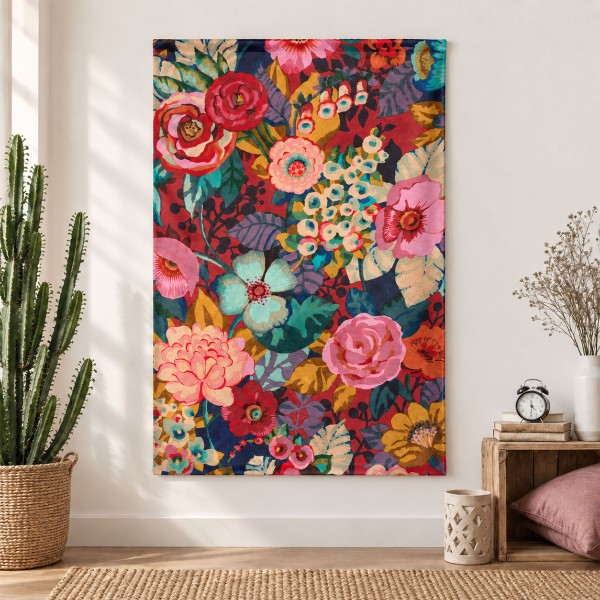
A 90 × 135 cm panel already fills an ordinary living-room wall. Shown here: LOUISON.
Three layouts work well:
The aligned diptych. Two identical or complementary panels, hung at the same height, 15 to 20 cm apart. The simplest option, and the safest above a sofa. Our patterns are designed to go in pairs: JAVA with TAÏNA, or KIMIKO with LOUISON.
The triptych. Three evenly spaced panels, on a wall of 4 m or more. Watch the ceiling height: three 135 cm panels need a wall with breathing room above and below.
The staggered layout. Two panels at different heights, about twenty centimetres apart. Freer, harder to pull off: the two patterns need a strong common thread—a shared dominant colour—otherwise it looks like a hanging mistake.
Whatever you choose, measure and mark out before driving in a single nail. Two panels whose tops are not aligned to the millimetre are noticed straight away.
And if you really want a very large panel
It is a legitimate choice, especially to cover an entire wall or hide an unattractive surface. In that case, check three things before ordering:
- The weight. Below 250 g/m² on a width of more than 2 m, the panel will ripple, whatever the product page says.
- How it hangs. A rod sleeve sewn across the full width, not spaced eyelets: on a large format, eyelets concentrate the tension and end up tearing.
- Care. Ask before you buy. Many very large formats are dry-clean only, which ends up costing more than the wall hanging itself after a few years.
What we offer
Vent de Bohème wall hangings come in a 90 × 135 cm format—a standard size, deliberately. It suits the most common situations in a living room (above a console table, a sideboard, an armchair), it hangs with two nails, it is machine washable, and two or three can be combined to dress a large wall.
If your project is to cover a 3-metre wall in one piece, we are not the right place, and we would rather say so frankly. If your project is to dress a large wall with a composition, our six patterns are designed to work together.
Frequently asked questions
What size wall hanging for a 3-metre wall? Aim for 150 to 200 cm in total width. That can be a single large-format panel, or two 90 cm panels spaced 15 to 20 cm apart.
Are there XXL wall hangings? Yes, up to 3 m wide, mostly in printed cotton from India. Check the weight: beyond 2 m wide, a lightweight fabric ripples.
Is one large wall hanging better than several small ones? Several panels are easier to hang, drape better, are simpler to look after and let you change the composition over time. A single panel gives a continuous mural effect.
How much space should you leave between two wall hangings side by side? 15 to 20 cm, with the tops perfectly aligned.
Do Vent de Bohème wall hangings come in a large format? They come in a 90 × 135 cm format. For a large wall, the solution is to combine them in twos or threes.
Read next: Wall hangings: the complete guide · How to hang a wall hanging · Which wall hanging for a modern living room?