
Your cart
There are no more items in your cart
Boho style rests on three principles: a warm, saturated palette rather than tone-on-tone, a confident layering of patterns from different origins, and the dominant presence of textiles — on the floor, on the seating, on the walls. The wall hanging holds a special place in it: it’s the piece that brings pattern up to eye level, where rugs and cushions stay down low.
Where the word comes from
In the 19th century, “bohemian” first described the life of penniless artists and writers in Romantic-era Paris — Murger, then Puccini. The word came to carry an idea: living surrounded by things you have chosen rather than things that match.
That remains the heart of the style. A boho interior isn’t an ethnic interior, or a hippie interior, or a Moroccan-inspired interior. It’s an interior put together over time, where objects come from different places and still speak to one another.
The distinction is practical, not theoretical: it explains why a boho interior that misses the mark looks like a souvenir shop, and why one that works doesn’t look decorated at all.
The three codes
1. Colour: warm, saturated and never on its own
The boho palette starts from earth tones — terracotta, ochre, saffron, brick — and adds bold colours: hot pink, turquoise, deep green, yellow. What sets it apart from a merely colourful interior is that no colour is left isolated: each one is picked up elsewhere in the room, on a smaller scale.
It’s the most useful rule of the style, and the easiest to apply. If you hang a wall hanging dominated by coral pink, that coral pink needs to be there already somewhere — a cushion, a book, a flower.
2. Pattern: layered, but not at random
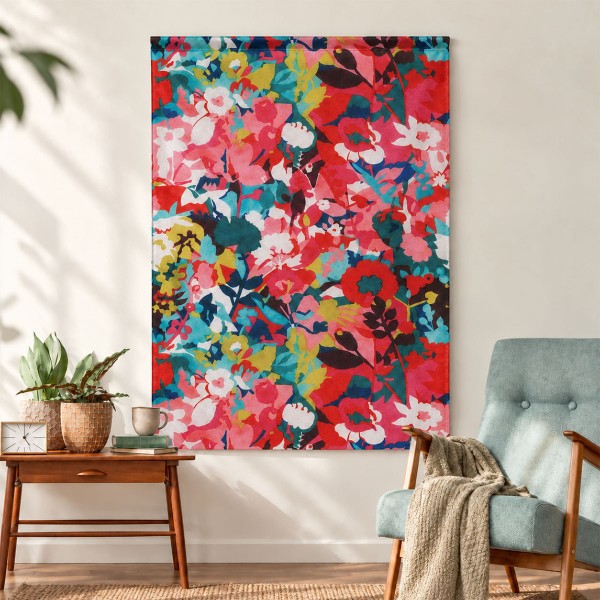
JAVA on the wall: a large pattern up high, smaller patterns below, one shared colour.
This is where it all comes together. Boho style layers patterns, which produces either richness or clutter. Three safeguards:
Vary the scale. A large pattern on the wall, a medium one on the cushions, a small one on a throw. Three patterns of the same size cancel each other out.
Share a colour. Patterns with nothing figurative in common can live together if they share a dominant colour.
Leave some empty space. A bare wall, a plain surface, a clear floor: these are what let the layering breathe.
3. Textiles everywhere, and at every height
Layered rugs, floor cushions, throws, pouffes, curtains. Textiles bring the warmth and the acoustics that give these interiors their particular comfort.
But all of that stays low. The wall hanging is the piece that lifts textiles up to eye level — and that is exactly what most unfinished boho interiors are missing: the floor is rich and the walls are bare.
The patterns of the boho family
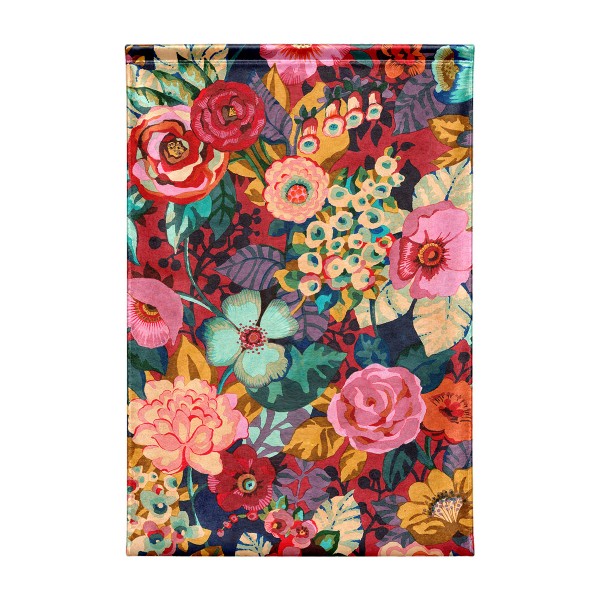
Lush florals, the boho pattern par excellence: LOUISON, roses and peonies on a burgundy background.
Lush florals. Dense bouquets, flowers spilling out of the frame, a dark or coloured background. It’s the boho pattern par excellence, a cousin of the antique printed cottons known in France as “indiennes”.
Botanicals and jungle. Foliage, palm fronds, graphic plants. Easier to work in than it looks: green goes with almost everything, and there are already plants in the room.
Tropical. Birds of paradise, hibiscus, orchids. The sunny version of the floral family.
Arabesques and paisleys. Inherited from the Persian and Indian repertoires, they bring the repeating pattern that gives a surface its structure.
Five common mistakes
Buying everything at once. A boho interior assembled in a single order looks like what it is: a stage set. This style is built up through successive additions.
Confusing boho with cluttered. Layering needs empty space to be seen.
Sticking to neutrals. Beige boho, widely shared on social media, is a different style — elegant, but not this one. Colour is fundamental.
Forgetting the walls. The most common mistake, as mentioned above.
Following a palette to the letter. These interiors thrive on their departures: the colour that shouldn’t work and yet holds everything together.
The Vent de Bohème collection
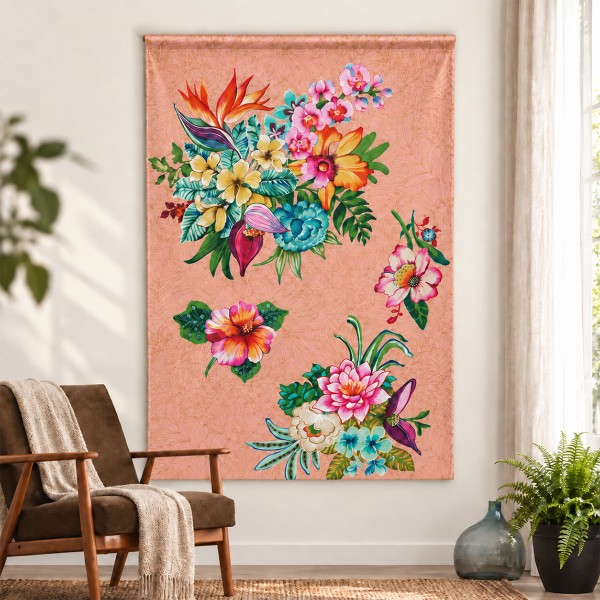
TAÏNA, the softest of the six: tropical bouquets on a powder-pink background.
This is our home ground, as the name says. Our six patterns are hand-drawn and printed on a 340 g/m² polyester velvet-effect fabric made in Milan, in a 90 × 135 cm format.
- TAÏNA — tropical bouquets, birds of paradise, hibiscus and orchids on a powder-pink background of delicate foliage. The softest in the collection.
- JAVA — a profusion of flowers and foliage cut out in flat blocks of colour, red and hot pink mixed with turquoise, deep green and white.
- PAJARO — a golden bird perched among large paisley arabesques, on a saffron-yellow background.
- LOUISON — roses, peonies and anemones in a lush bouquet, on a burgundy and midnight-blue background. The darkest, and the best anchor point in a very light room.
- KIMIKO — large, finely drawn stylised flowers in coral pink, red and gold, on teal-blue foliage.
- BOA — a faceted graphic jungle in shards of turquoise, yellow, red and pink. The most contemporary.
Frequently asked questions
What is a boho wall hanging? A textile wall panel with lush patterns — floral, botanical, tropical or arabesque — in a warm, saturated palette, designed for an interior that layers patterns rather than matching them.
What’s the difference between boho style and ethnic style? Ethnic style refers to one specific cultural area. Boho mixes origins and is built up over time; it’s a principle of composition, not a geography.
What colours work in a boho interior? Warm earth tones — terracotta, ochre, saffron — lifted with bold colours. The rule is that no colour is left isolated: each one is repeated elsewhere, on a smaller scale.
How do you mix several patterns without overdoing it? Vary the scale, give the patterns a shared dominant colour, and keep some plain surfaces so the whole can breathe.
Where should you hang a wall hanging in a boho interior? Above a low piece of furniture, a bed or an armchair. It’s the piece that lifts textiles up to eye level, where rugs and cushions stay on the floor.
Read next: Which wall hanging for a modern living room? · Wall hangings from around the world · see all six patterns