
Your cart
There are no more items in your cart
“Oriental”, “African” and “Asian” are catalogue labels, not styles. Behind each of them lie specific textile traditions, with different techniques and different patterns: kilim geometries and Persian arabesques on one side, Malian bogolan and West African wax prints on the other, Indonesian batik or Chinese brocade for Asia. Knowing what you're looking at changes the way you choose.
Why these words don't mean much
Every month, search engines record dozens of searches for “oriental wall hanging”. The word is useful for searching; it's useless for deciding. Depending on the era, “Oriental” has referred to North Africa, Turkey, Persia, India and sometimes China—so many textile traditions with nothing in common.
Digging deeper isn't an academic exercise: an Anatolian kilim and a Persian arabesque don't belong in the same interior, don't go with the same colours and don't cost the same.
The Mediterranean and the Middle East
Kilim geometries
A kilim is a flatweave, with no pile, whose patterns are geometric by construction: the technique imposes broken lines and stepped diagonals. Diamonds, hooks, combs—each shape has a name and a meaning in its region of origin.
What it looks like on a wall: earthy colours, a visible weave and a very strong graphic presence. A hung kilim is heavy and needs proper fixings.
Arabesques and the art of the infinite pattern
Islamic art developed ornamental repertoires of rare richness: interlacing foliage, star-shaped geometries, calligraphy. The principle is often that of a pattern that continues beyond the frame—it has no apparent beginning or end.
What it looks like on a wall: a dense, regular pattern that works best in a large format and on a clear wall.
West Africa
Bogolan
A Malian technique: cotton is dyed with plant decoctions and then painted with fermented mud, which reacts chemically with the dye. Hence its deep blacks, its ochres and its hand-drawn geometric patterns.
What it looks like on a wall: a limited palette—earth, ecru, black—and a visibly handcrafted texture. It's one of the few families that naturally suits understated contemporary interiors.
Wax prints
Wax-printed on cotton, colourful, with figurative patterns that often carry messages. Its history is more complex than it seems: born of European industrial imitations of Indonesian batik, it was reclaimed in West Africa to the point of becoming emblematic of the region.
What it looks like on a wall: bold colours and a pattern you can see from afar. Treat it as a statement piece, alone on its wall.
Raffia textiles and Kuba cloth
Woven in the Democratic Republic of the Congo, with irregular geometric patterns that greatly inspired 20th-century painters. Most often small formats, superb framed or pieced together.
Asia, beyond Japan and India
Indonesian batik: wax resist applied by hand or with a copper stamp, fine patterns, deep brown and blue in the Javanese tradition.
Chinese brocades and silks: patterns woven in coloured or gold thread, symbolic subjects—dragons, peonies, clouds.
Textiles of Southeast Asia's minority peoples: Hmong embroidery, ikats and indigos, with dense geometries and extremely fine work.
→ The two traditions most searched for in France each have their own article: Indian wall hangings and Japanese wall hangings.
Three rules for decorating with a world wall hanging
One room, one origin. A kilim, a bogolan and a wax print in the same living room tell no story other than the catalogue they came from. One statement piece is enough.
Let it be the focus. Almost all of these textiles are dense. A clear wall, calm furniture, no competing pattern nearby.
Find out about what you're buying. Not out of scruple, but because that's what distinguishes a handcrafted piece from an industrial reproduction—and because knowing the object you hang in your home makes life more interesting.
And at Vent de Bohème?
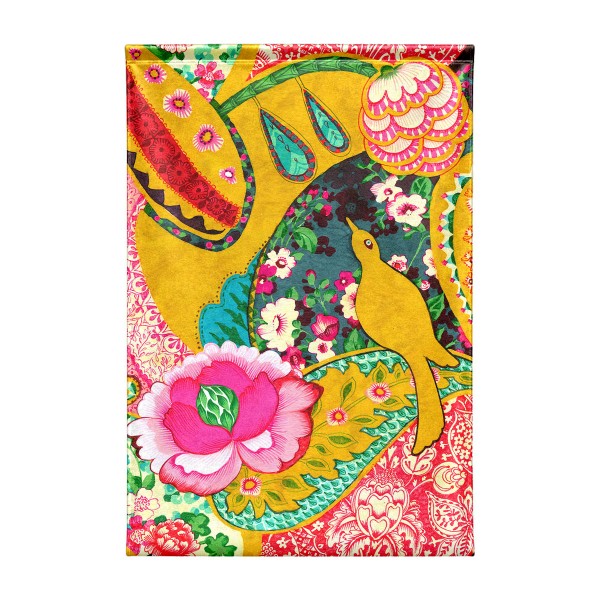
A love of dense patterns and bold colour, without claiming any tradition: PAJARO.
Our wall hangings don't belong to any of these traditions, and we don't present them as such. They are hand-drawn patterns created for the brand, printed on a fabric made in Milan.
What links them to this family is a love of dense patterns and bold colour, which you'll find in PAJARO and its paisley arabesques, in JAVA and its cut-out flowers in flat colour, or in TAÏNA and its tropical bouquets.
Frequently asked questions
What is an oriental wall hanging? The term is a commercial one and covers very different traditions: Anatolian kilims, Persian arabesques, North African textiles. It's better to look for the specific technique than the label.
What is bogolan? A Malian cotton textile dyed with plant decoctions and then painted with fermented mud, with hand-drawn geometric patterns in a palette of earth tones and blacks.
Is wax print an African fabric? It was born of European industrial imitations of Indonesian batik, then reclaimed in West Africa, where it has become a cultural marker in its own right.
How do you combine several wall hangings from different origins? It's best not to. One statement piece per room, in calm surroundings, gives a more fitting result than an accumulation of origins.
Read next: Indian wall hangings · Japanese wall hangings · Boho wall hangings