
Your cart
There are no more items in your cart
High-end wall hangings are mainly made from velvet (cotton, silk or polyester), thick linen and heavy cotton. But the material alone is not enough to judge by: the deciding factor is the fabric weight, expressed in grams per square metre. Below 250 g/m², a panel ripples and creases; above 300, it hangs straight as soon as it goes up. Next come the quality of the printing and of the finishing.
Fabric weight comes before the name of the material
A wall hanging is not a garment. You don't wear it, you don't rub it: you look at it, flat, vertically, sometimes for years. What you ask of it is to hang straight and keep its colours.
The drape depends first and foremost on the weight of the fabric:
| Weight | How it behaves on a wall |
|---|---|
| Under 200 g/m² | Floats, buckles, lets the wall show through |
| 200 to 250 g/m² | Holds, but keeps the fold marks for a long time |
| 250 to 300 g/m² | Decent; one ironing when unpacked is enough |
| 300 to 400 g/m² | Hangs straight as soon as it goes up, no ironing needed |
| Over 400 g/m² | Beautiful, but heavy to fix and expensive |
That is why a product page that doesn't mention the fabric weight should make you wonder. It isn't hard information to publish; when it's missing, it's rarely because the figure is flattering.
The main materials, honestly compared
Cotton or silk velvet
This is the noble fabric of the family, and the one people picture when they say “velvet”. Deep, shifting with the light, with an incomparable hand.
Two limitations, rarely mentioned: digital printing doesn't take well on it—the pile deflects the ink and the design loses sharpness—and it can't be machine washed. A cotton velvet printed with fine patterns is therefore either very expensive (hand screen printing) or disappointing.
It's the material for one-off wall hangings, not for hangings printed with a precise design.
Linen
The liveliest drape, a surface irregularity that gives character, and a genuinely noble material. But linen creases—that's its nature—and its thick grain softens the outlines of a graphic pattern. It suits large designs and natural shades, less so detailed patterns.
Heavy cotton
The best compromise for a matt print. A 280 to 350 g/m² cotton takes printing well, is washable and reasonably priced. Its drawback: it has no depth at all—the colour stays on the surface, and a cotton wall hanging can sometimes look like a large-format poster.
Polyester velvet-effect
This is the most widely used fabric for printed wall hangings today, and not only for reasons of cost. It combines three things that no other material brings together: it takes digital printing with complete sharpness, it has the colour depth and play of light of velvet, and it is dimensionally stable—it doesn't stretch, doesn't shrink and doesn't buckle with the humidity of the room.
Some are machine washable, which completely changes how you can use them.
Its reputation suffers from being confused with thin polyesters, the ones used for ten-euro hangings that flap in the slightest draught. It's not the same thing: between a 120 g/m² polyester and a 340 g/m² polyester velvet-effect fabric, there is the same gap as between a T-shirt and a coat.
What we use, and why
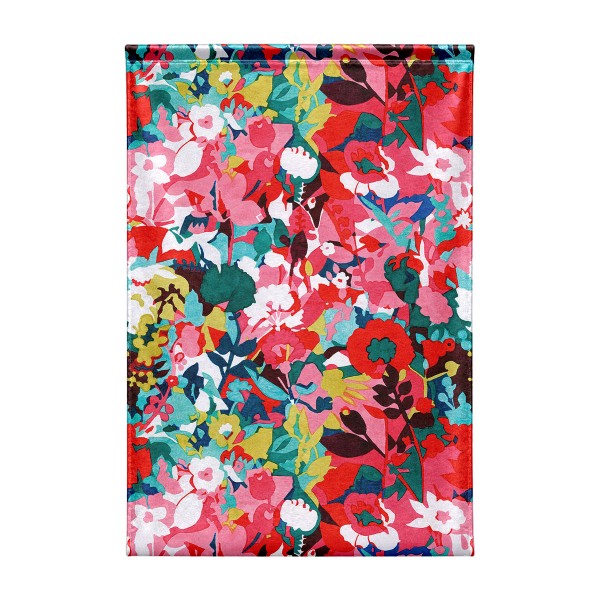
340 g/m², woven and printed in Milan: you can see the density in the way the panel hangs. Shown here: JAVA.
Vent de Bohème wall hangings are printed on a 340 g/m² polyester velvet-effect fabric, made in Italy, in Milan.
This choice is the result of a deliberate trade-off. Our patterns are hand-drawn, with fine lines, gradients and bold colours: a golden bird on a saffron background, paisley arabesques, faceted foliage. These designs need sharp printing—something cotton velvet can't deliver without losing detail.
And 340 g/m² is the point where the panel hangs straight as soon as you put it up, with no ironing, while staying light enough to hold on two nails: a 90 × 135 cm wall hanging weighs 450 g.
Add to that what you can't see in a photo: the fabric is machine washable at 30 °C and can be ironed on the reverse.
The finishing: the second criterion, often forgotten
Two wall hangings in the same fabric can age very differently.
- Hems should be present on all four sides. A raw cut edge, even heat-sealed, frays and ripples within a few months.
- The hanging system: a sleeve sewn across the full width spreads the tension. Eyelets set into the fabric concentrate it on a few points, and that's where it tears first.
- The straight grain: the pattern must be printed square to the weave. A design that is slightly on the bias gives a wall hanging that will never hang straight, whatever you do.
How to judge a fabric on a screen
Four checks before ordering, whatever the shop:
- Is the fabric weight stated? If not, ask for it.
- Are the care instructions specified? “Dry clean only” isn't a flaw, but you need to know beforehand.
- Is there a room-setting photo, with a piece of furniture alongside? It's the only way to judge the size and the drape.
- Is the place of manufacture named? Not as a patriotic argument, but because a brand that knows where its fabric is made generally also knows what's in it.
Frequently asked questions
What is the best fabric for a wall hanging? There isn't just one: cotton velvet for an unprinted one-off piece, linen for a large, natural pattern, heavy cotton for a matt print, polyester velvet-effect for a detailed pattern with depth of colour. In every case, aim for more than 300 g/m².
What fabric weight should a wall hanging be? At least 250 g/m², ideally between 300 and 400. Below that, the fabric buckles and keeps its creases.
Is polyester poor quality for a wall hanging? It depends entirely on the weight. A thin 120 g/m² polyester floats and looks shiny; a 340 g/m² polyester velvet-effect fabric hangs straight, offers real depth of colour and is often machine washable.
Can you wash a velvet wall hanging? Cotton and silk velvets are dry clean only. Some polyester velvet-effect fabrics can go in the machine—Vent de Bohème wall hangings are washable at 30 °C.
Why does fabric weight matter more than the material? Because a wall hanging is judged on its drape. It's the weight of the fabric, not its name, that determines whether it hangs straight or ripples.
Read next: Wall hangings: the complete guide · How to clean and care for a wall hanging · see our six patterns