
Your cart
There are no more items in your cart
A wall hanging needs dusting two or three times a year with a soft brush or a vacuum cleaner on low power, working in the direction of the fabric. Depending on the material, it is then either dry-cleaned or machine-washed: Vent de Bohème wall hangings go in the machine at 30 °C and are ironed on the reverse. A stain should be dabbed with cold water, never rubbed.
It's the question that puts many people off textile wall art: won't a piece of fabric on the wall turn into a dust trap that's impossible to clean? Short answer: no, and far less so than a curtain, which catches the air from the window. Here's what you need to know, material by material.
Everyday care: dust
A wall hanging on an interior wall gets dirty slowly. Two or three dustings a year are enough in a normal room, more in an open-plan kitchen or if you have a wood burner.
The method: a soft clothes brush, or the vacuum cleaner on its lowest setting with the brush attachment, moved in the direction of the fabric—from top to bottom on a velvet-effect fabric, so you don't brush the pile the wrong way. Hold the bottom of the wall hanging with one hand so you don't pull on the fixings.
What to avoid: the vacuum cleaner on full power without an attachment, which sucks up the fabric and pulls on the seams, and the feather duster, which moves dust around without removing it.
Stains
The gesture that fixes it: dabbing. The gesture that makes it worse: rubbing. On a pile fabric, rubbing flattens the fibres and leaves a pale mark that is more visible than the original stain, even once the stain itself has gone.
- First soak up the excess with a clean, dry cloth, without pressing.
- Dab with cold water, working from the edge of the stain towards its centre.
- If needed, use a little diluted mild soap, then rinse by dabbing with clean water.
- Leave to air-dry, with the wall hanging taken down and laid flat if possible.
Hot water sets most organic stains: always start with cold.
Washing: it depends entirely on the material
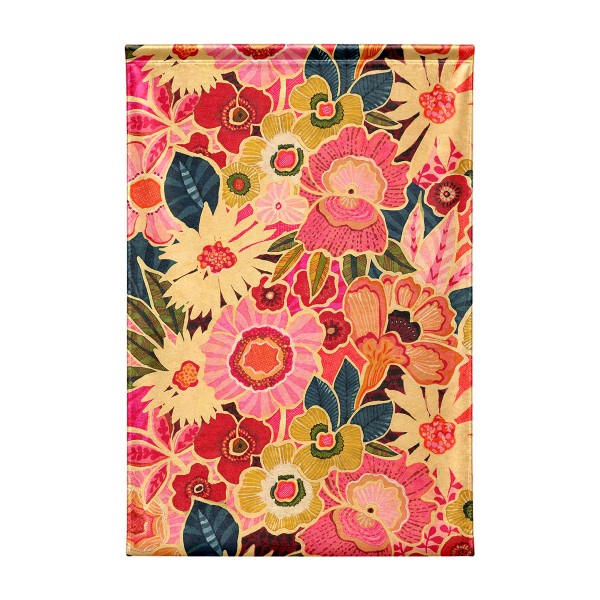
The printed velvet-effect polyester of our wall hangings is machine-washable at 30 °C—shown here: KIMIKO.
This is where wall hangings really differ from one another, and it's something to check before you buy.
| Material | Washing |
|---|---|
| Cotton or silk velvet | Dry cleaning, in most cases. Washing marks the pile. |
| Printed cotton | Cold machine wash, delicate cycle, minimal spin |
| Linen | Delicate, creases a lot, iron while damp |
| Velvet-effect polyester | Varies—many are dry-clean only, some are machine-washable |
Vent de Bohème wall hangings are machine-washable at 30 °C and are ironed on the reverse. That's unusual for this type of fabric, and it changes how you can use them: a washable wall hanging can live in a child's bedroom, an open-plan kitchen or a living room where you eat, without the first stain being a disaster.
Three precautions, which apply to any printed textile:
- Remove the rod if you have slid one into the sleeve.
- Wash it on its own or with similar colours, especially the first time.
- Take the wall hanging out as soon as the cycle ends and hang it up. That's what prevents most creases, and it often means you don't need to iron at all.
Creases
A wall hanging delivered folded arrives with fold marks. Nine times out of ten, all you need to do is hang it up and wait 48 hours: the weight of the fabric does the work.
If any creases persist, iron on the reverse, never on the right side: an iron placed directly on a pile fabric crushes it and leaves an irreversible shine. If you don't have an iron, steam held at a distance, with the wall hanging hung up, relaxes the fabric without touching it.
Light
Every printed textile changes under direct light. A wall hanging facing a south-facing picture window, exposed all day long, will fade faster than one on a side wall. That's not a manufacturing defect; it's how pigments normally behave.
Two simple solutions: avoid the wall that gets the full afternoon sun, or rotate your wall hangings from one room to another as the seasons change—which is exactly the appeal of something you can take down in ten seconds.
Can you shorten a wall hanging?
It's a question that comes up often, usually when the wall is lower than expected or a piece of furniture is in the way.
First, try not to cut it. All four sides of a finished wall hanging are hemmed: the bottom is part of the finish. Lowering the fixing points by a few centimetres solves most cases, and a bottom edge that falls slightly behind a piece of furniture won't be noticed.
If the height really doesn't work, a new machine-sewn hem is possible. Cut above the original hem, fold over twice to enclose the raw edge, and sew with a straight stitch. On a pile fabric, this takes a little practice: if you don't sew, an alterations shop will do it in a few minutes.
What not to do: cut it straight without hemming. The edge will fray and the wall hanging will lose its shape within a few weeks.
Storing between seasons
Roll, don't fold. A wall hanging rolled up, pattern facing outwards, around a cardboard tube or simply on itself, comes out without a mark. Folded and stored under a pile, it keeps its creases for months.
Store it away from light and damp, wrapped in fabric or tissue paper—not in a sealed plastic bag, which traps moisture.
Frequently asked questions
How do you clean a wall hanging without taking it down? Use a soft brush or a vacuum cleaner on low power with the brush attachment, in the direction of the fabric, holding the bottom with your free hand. For a stain, dab with cold water without rubbing.
Can a wall hanging be machine-washed? It depends on the material: cotton and silk velvets are dry-cleaned, while most printed cottons can be machine-washed cold. Vent de Bohème wall hangings wash at 30 °C and are ironed on the reverse.
How do you get creases out of a wall hanging? Hang it up for 48 hours: the weight of the fabric is almost always enough. Otherwise, iron on the reverse, or steam it from a distance without putting the iron on the fabric.
How do you shorten a wall hanging? The simplest option is to lower the fixing points. If the height doesn't work, cut above the original hem and sew a new double hem by machine—never leave a raw cut edge.
Does a wall hanging collect dust? Less than a curtain, which catches the air from the window. Dusting two or three times a year is enough in a normal room.
Read next: Wall hangings: the complete guide · How to hang a wall hanging · our wall hangings