
Your cart
There are no more items in your cart
An Indian wall hanging is a panel of printed or painted cotton rooted in the textile traditions of the subcontinent: wood-block printing (block print) from Rajasthan, reed-pen painting (kalamkari) from the South, embroidery from Gujarat. Its best-known patterns in Europe are the mandala, the tree of life and the boteh—the teardrop motif the West calls paisley. It works in any interior, as long as you give it a wall of its own.
A textile that was never merely decorative
India has been printing cotton for more than two thousand years, and these textiles were among the great trade goods of the ancient world: Indian printed cottons have been found in Egyptian excavations, and trade with Europe in the 17th and 18th centuries was so extensive that France banned the import of “indiennes” for a time to protect its own manufacturers.
These fabrics served as door hangings, canopies, altar cloths and quilts. The decorative panel hung on a European living-room wall is a recent use; the textile itself is ancient.
The main techniques
Block print
The best known. Hand-carved wooden blocks, one per colour, pressed one after another onto the stretched fabric. Each block is lined up by eye, which creates those slight misalignments between the colours—the hallmark of the process.
How to recognise it: look at the outlines. A block print shows small irregularities and denser ink at the edges of the motif; a digital print is perfectly uniform.
Kalamkari
A technique from southern India in which the pattern is drawn with a kalam, a bamboo pen, often using plant-based dyes. The line is fine, narrative, close to drawing. Kalamkari traditionally tell episodes from mythology.
Embroidery and appliqué
From Gujarat and Rajasthan, sometimes with small mirrors sewn in (shisha). These are the most handcrafted pieces, often the most expensive, and the ones that age best.
The three patterns you see everywhere, and what they mean
The mandala. A concentric circular diagram used as an aid to meditation in the Hindu and Buddhist traditions. It is by far the most widespread motif in the West, often stripped of all context. Knowing this won't change your decor, but it stops you treating it as a simple rosette.
The tree of life. A tree bearing birds and flowers, found in Indian textiles as well as in Persian and European tapestries. Its popularity probably comes from its universality: almost every culture has depicted this tree.
The boteh, or paisley. The curved teardrop motif, born in Persia, spread by Kashmir shawls, and renamed “paisley” in the West after the Scottish town that industrialised it in the 19th century. It is one of the few patterns to have travelled around the world, changing its name at every stop.
How to use it without ending up with a themed-restaurant look
A few simple principles you can actually stick to.
A dense pattern needs empty space around it. This is the rule that matters most. An Indian wall hanging is busy by nature: fine outlines, infills, repeats. It needs a clear wall and calm furniture. Against a printed sofa and a patterned rug, it gets lost in the noise.
One piece per room. One wall hanging, and keep the rest understated. Two Indian wall hangings plus matching cushions plus a copper lamp, and you tip over into a themed set.
Watch the light. Hand-printed cottons are often dyed with pigments that are less stable than industrial printing. Avoid the wall that gets the afternoon sun.
Check the weight. Large Indian formats are usually made of lightweight cotton. That's what keeps them affordable, and it's also what makes them ripple once they're wider than two metres.
This repertoire at Vent de Bohème
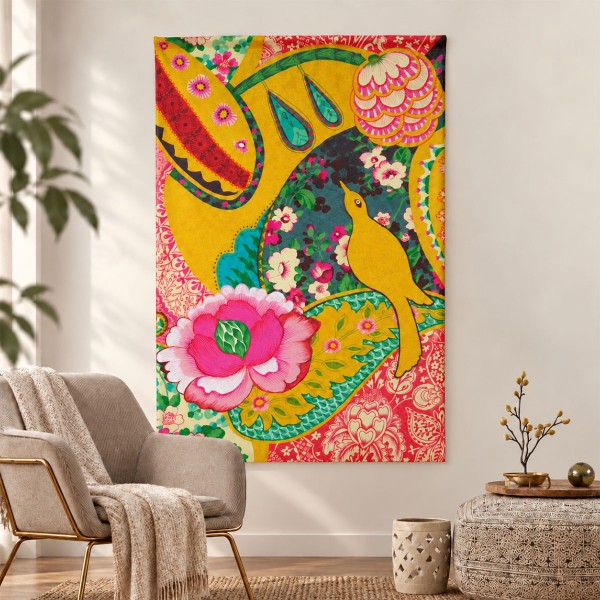
PAJARO and its large paisley arabesques, inherited from the Indian repertoire.
We don't sell Indian wall hangings: our wall hangings are printed on a polyester velvet-effect fabric made in Milan, from patterns hand-drawn for the brand.
But the Indian decorative repertoire is part of what inspires us, and it shows most clearly in PAJARO: a golden bird perched among large paisley arabesques, a pink peony and a garden of small flowers, on a saffron-yellow background. The boteh is used there as a shape, not as a quotation.
In a different register, LOUISON plays on an abundance of flowers on a dark background—the same garden-like density you find in old indiennes.
Frequently asked questions
What is an Indian wall hanging? A textile panel, almost always cotton, rooted in the printing and painting traditions of the Indian subcontinent: wood-block printing, kalamkari painted with a reed pen, or embroidery.
How can you recognise a hand block print? By the small misalignments between the colours and the denser ink along the outlines. A digital print is perfectly uniform.
What does the tree of life pattern mean? It is a universal image, found in Indian textiles as well as in Persian and European tapestries: a tree bearing birds and flowers, a symbol of fertility and continuity.
Is paisley Indian or Persian? The boteh was born in Persia, spread through Kashmir shawls, and took the name “paisley” in the West, after the Scottish town that industrialised it in the 19th century.
How do you decorate with an Indian wall hanging without overdoing it? One piece per room, on a clear wall, with calm furniture and textiles around it.
Read next: Japanese wall hangings · Wall hangings from around the world · see PAJARO