
Your cart
There are no more items in your cart
Japanese hanging textiles cover several distinct objects: the noren, a short split curtain hung in a doorway; the modern decorative tapestry; and the furoshiki, a square of cloth for tying that is sometimes framed. What they have in common is not the pattern but the composition: one subject, a great deal of empty space, and a line that goes straight to the essential. That is what makes them so easy to live with in a contemporary interior.
The noren, where it all began
A noren is a short fabric curtain, split vertically into two, three or four panels, hung from a rod in a doorway. You see it at the entrance to restaurants, public baths and small shops: it shows that the place is open, screens the view without closing it off, and lets the air through.
Two things to take from it for decorating.
A noren is meant to be walked through. It is not made to be looked at from afar like a painting, but to be brushed aside as you pass. That is why its pattern is usually simple and readable in an instant.
It divides without walling off. This is an idea you can use directly at home: hang a textile panel in a doorway to mark a threshold—between a living room and a study, in front of an open wardrobe, at the entrance to a kitchen.
The repertoire of patterns
Traditional Japanese patterns work as a codified repertoire, in which each shape carries a meaning.
Seigaiha, concentric waves. Overlapping semicircles arranged like scales, representing the sea. An ancient pattern, associated with peace and constancy.
Asanoha, the hemp leaf. A geometric grid of six-pointed stars, traditionally used for children's clothing: hemp grows fast and straight.
Cranes and waves. The crane is one of the great symbols of longevity; paired with the pine or the tortoise, it forms compositions expressing good wishes.
Seasonal flowers. Cherry blossom in spring, peony in summer, chrysanthemum in autumn, plum blossom in winter. The floral calendar shapes a large part of Japanese decorative art.
Landscapes. Mountains, mist, lone trees, rendered in broad flat areas of colour with very distinct planes.
What really makes the style: composition, not subject
This is the point most articles miss. What sets a Japanese wall hanging apart from a Western floral one is not the motif depicted but the way it occupies the surface.
Three principles run through all Japanese decorative art:
Emptiness is a material. The background is not a space to be filled. A motif placed in a corner, with two thirds of the surface left bare, is a finished composition—not an unfinished one.
Asymmetry rather than centring. The subject is rarely in the middle. It is off-centre, runs out of the frame, and leaves you to imagine the rest.
Economy of line. One outline, one colour, no gratuitous gradients. That is what makes these patterns so readable from a distance.
This economy explains why a Japanese wall hanging settles so easily into a contemporary interior: it does not compete with the furniture.
How to work it into your home
Give it a calm wall. The empty space in the pattern needs empty space around it. A Japanese wall hanging squeezed between a bookcase and a picture frame loses all its appeal.
Respect the scale. These compositions are designed to be seen from a little way off. In a narrow corridor, a pattern of large waves becomes unreadable.
Don't feel you have to centre it. Since the composition is asymmetrical, hanging it slightly off-centre in relation to the piece of furniture below often works better than perfect centring.
To divide a space, look for a real noren, split, hung from a rod in the doorway. A solid wall hanging hung in a doorway lifts up and gets in the way as you pass.
This repertoire at Vent de Bohème
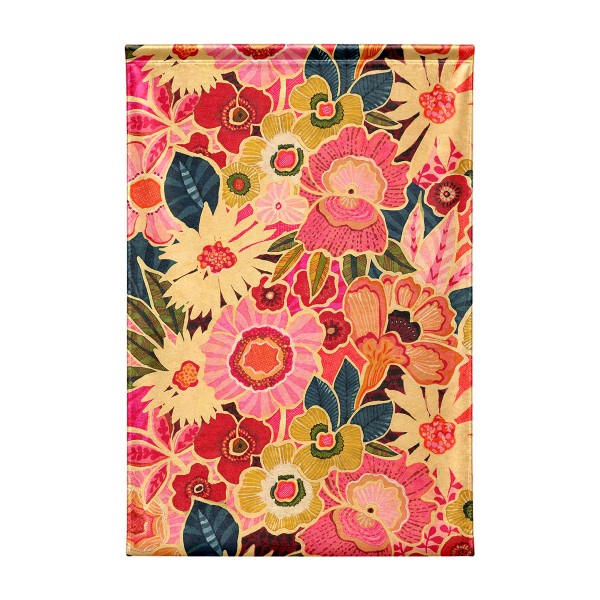
KIMIKO: the flower drawn in line rather than filled in, with empty space left around it.
Our wall hangings are not Japanese textiles: they are printed on a fabric made in Milan, from patterns hand-drawn for the brand.
But that economy of means—the fine line, the stylised rather than naturalistic flower—runs through KIMIKO: large flowers drawn in line, in coral pink, red and gold, on teal-blue foliage. Here, the drawing matters more than the fill.
In an even more graphic spirit, BOA cuts its jungle into crisp facets, with the kind of separation of planes found in woodblock prints.
Frequently asked questions
What is a noren? A short fabric curtain split vertically, hung in a doorway. In Japan, it signals that a business is open and screens the view without blocking the way through.
What are the traditional Japanese patterns? Concentric waves (seigaiha), the hemp leaf (asanoha), cranes, seasonal flowers—cherry blossom, peony, chrysanthemum, plum blossom—and mountain landscapes.
How can you decorate in a Japanese style without overdoing it? Leave empty space. A single piece, on a clear wall, with a pattern that reads from a distance. Too many symbols produce the opposite of the effect you are after.
Can you use a wall hanging to separate two rooms? Yes, that is the traditional use of the noren. Choose a split design, hung from a rod in the doorway: a solid panel lifts up as you pass.
What is the difference between a Japanese and an Indian wall hanging? Density. An Indian wall hanging fills the surface with repeated patterns; a Japanese one sets down a single subject and leaves the rest empty.
Read next: Indian wall hangings · Wall hangings from around the world · see KIMIKO