
Your cart
There are no more items in your cart
Sewing a wall hanging is a simple project: a rectangle of fabric, four hems and a rod sleeve at the top. Two hours for someone who sews, an afternoon for a beginner. The real calculation lies elsewhere: a quality upholstery fabric costs between €30 and €80 per metre, and the hand-drawn pattern of a designer wall hanging isn't sold by the metre. You make your own for a made-to-measure size; you buy for the design.
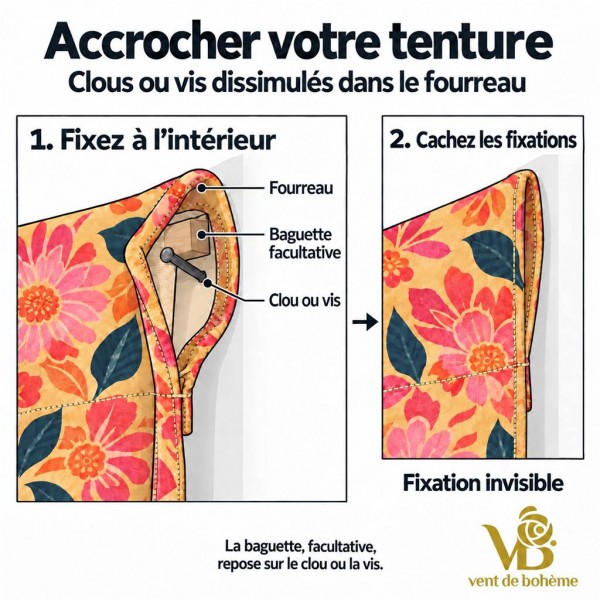
The rod sleeve sewn along the top of a wall hanging: this is what takes the rod—or, quite simply, two nails.
We sell wall hangings. We've written this tutorial all the same, because if you're going to sew one, it might as well be done properly.
When making your own is the right decision
You need a size you can't find anywhere. A 2.40 m wall under the stairs, a narrow alcove, a panoramic format. It's the best reason, by a long way.
You already have the fabric. A remnant brought back from a trip, a second-hand curtain, a family heirloom fabric. Then the question doesn't even arise.
You want to sew. A perfectly good reason in itself.
When it's a false economy
To save money. A decent upholstery fabric—over 250 g/m², 140 cm wide—goes for between €30 and €80 per metre. For a 90 × 135 cm panel, allow 1.50 m of fabric, so €45 to €120 in materials, before the rod and the time spent. A designer wall hanging falls within the same range: ours is €129.99.
To get a specific pattern. This is the deciding factor. Fabrics sold by the metre are rarely large-scale patterns: they're repeat prints, designed for curtains and cushions. A designer wall hanging features a design composed for that format—a bouquet that fills the surface, a bird placed exactly where it should be. It's not the same thing, and it can't be cut by the metre.
Because it looks easy. It is. But the finishing shows: a hem that pulls, a sleeve that's too narrow, a pattern cut off-grain. On something you look at every day, near enough isn't good enough.
The tutorial, if you're giving it a go
Choosing the fabric
Aim for over 250 g/m²—any lighter and the panel will ripple whatever you do. Upholstery cotton, thick linen or upholstery velvet all work. Check the fabric width (the width of the roll): at 140 cm, a 90 cm wide panel can be cut in one piece with no joins.
Ask for a sample before ordering several metres, and let the fabric relax flat for 24 hours before cutting.
Working out quantities
For a finished 90 × 135 cm panel:
- Width: 90 + 2 × 2 cm for a double-folded hem = 94 cm of fabric
- Height: 135 + 3 cm at the bottom + 8 cm at the top for the sleeve = 146 cm, rounded up to 1.50 m
Add 10% if the pattern needs precise placement.
Cutting straight
The step everyone rushes, and the one that decides the result. A panel cut even slightly off-grain will never hang straight.
On a woven fabric, pull out a weft thread and cut along the gap it leaves: it's foolproof. On a non-woven fabric, mark it out with a ruler and set square, on a large table, never on your lap.
The hems
On the sides and bottom: fold over 1 cm, press, fold over another 1 cm, press, then straight-stitch 2 mm from the inner edge. The double fold encloses the raw edge—that's what stops it fraying.
Do the sides first, then the bottom: the corners are neater in that order.
The rod sleeve
At the top, fold over 1 cm, press, then fold over 6 to 7 cm and stitch 5 mm from the folded edge. You end up with a tunnel about 5 cm wide—enough for a standard round rod, and enough to hide two nails if you hang it without a rod.
Don't make the sleeve too tight: a rod that has to be forced in puckers the fabric across the whole width.
The final press
Iron on the reverse side, with all the hems flat. On a fabric with a pile, never put the iron on the right side.
The three mistakes that keep coming up
Fabric that's too light. The most common one. A voile, a shirting cotton or a thin polyester won't hang straight.
A cut edge left unhemmed. An edge finished with fusible tape or cut with pinking shears frays within a few months and the panel loses its shape.
A sleeve that's too narrow. Measure your rod before you sew, not after.
And if you want the result without the workshop
Vent de Bohème wall hangings measure 90 × 135 cm, are printed on a 340 g/m² polyester velvet-effect fabric made in Milan, hemmed on all four sides and finished with a rod sleeve—everything described above, in short, plus a hand-drawn pattern designed to fill that exact format.
They're machine washable at 30 °C, which upholstery velvet bought by the metre almost never is.
Frequently asked questions
How do you make a wall hanging yourself? Cut a rectangle of fabric of at least 250 g/m², double-fold hem the sides and bottom, then make a 5 to 7 cm sleeve at the top to take a rod. Allow two hours if you already sew.
What fabric should I buy by the metre for a wall hanging? Upholstery cotton, thick linen or upholstery velvet of over 250 g/m². Check the fabric width: at 140 cm, a 90 cm panel can be cut with no joins.
How much fabric do you need for a 90 × 135 cm wall hanging? About 1.50 m of 140 cm wide fabric, including hems and sleeve.
Is it cheaper to make your own wall hanging? Rarely. A decent upholstery fabric costs €30 to €80 per metre: the materials alone come to the price of a designer wall hanging. You make your own for a made-to-measure size, not to save money.
Can you make a wall hanging without a sewing machine? With iron-on hemming tape, yes, for a temporary result. Glued hems give way at the first wash and come unstuck with heat.
Read next: What fabric for a high-quality wall hanging? · How to hang a wall hanging · Wall hanging: the complete guide